
In brief
The RECAPTURE project is developing an innovative, hybrid CO₂ capture system based on additively manufactured, functionalised porous structures. By combining 3D printing, optimised geometry and chemical modification, the aim is to significantly improve the efficiency, regenerability and scalability of CO₂ capture and make it suitable for industrial applications.
What we’re working on
Motivation
The rising concentration of anthropogenic CO₂ emissions requires not only emission avoidance but also high-performance technologies for CO₂ capture and utilisation. Existing processes often reach their limits in terms of energy consumption, mass transfer and regeneration effort. RECAPTURE addresses these challenges by developing a novel system that combines high efficiency with good scalability. The aim is to capture CO₂ directly at industrial point sources and make it available for downstream utilisation processes.
Innovative approach
At the heart of the project is the combination of additive manufacturing using Digital Light Processing with functionalised adsorption materials. The use of complex porous structures enables the surface area and flow to be specifically optimised, whilst reducing pressure losses. The subsequent chemical functionalisation and impregnation combine the advantages of solid adsorbents with the high binding capacity of liquid systems. This results in a hybrid, regenerable adsorbent system with high performance.
Implementation and added value
Implementation is achieved through simulation-aided geometry optimisation, additive manufacturing, thermal post-treatment and targeted chemical functionalisation. The result is highly porous, mechanically stable and regenerable adsorbent structures. The added value lies in improved CO₂ capture performance with reduced energy consumption and low pressure drop. At the same time, the modular approach opens up significant potential for industrial-scale application and contributes to the development of sustainable CCU technologies and a circular carbon economy.
Material from the project
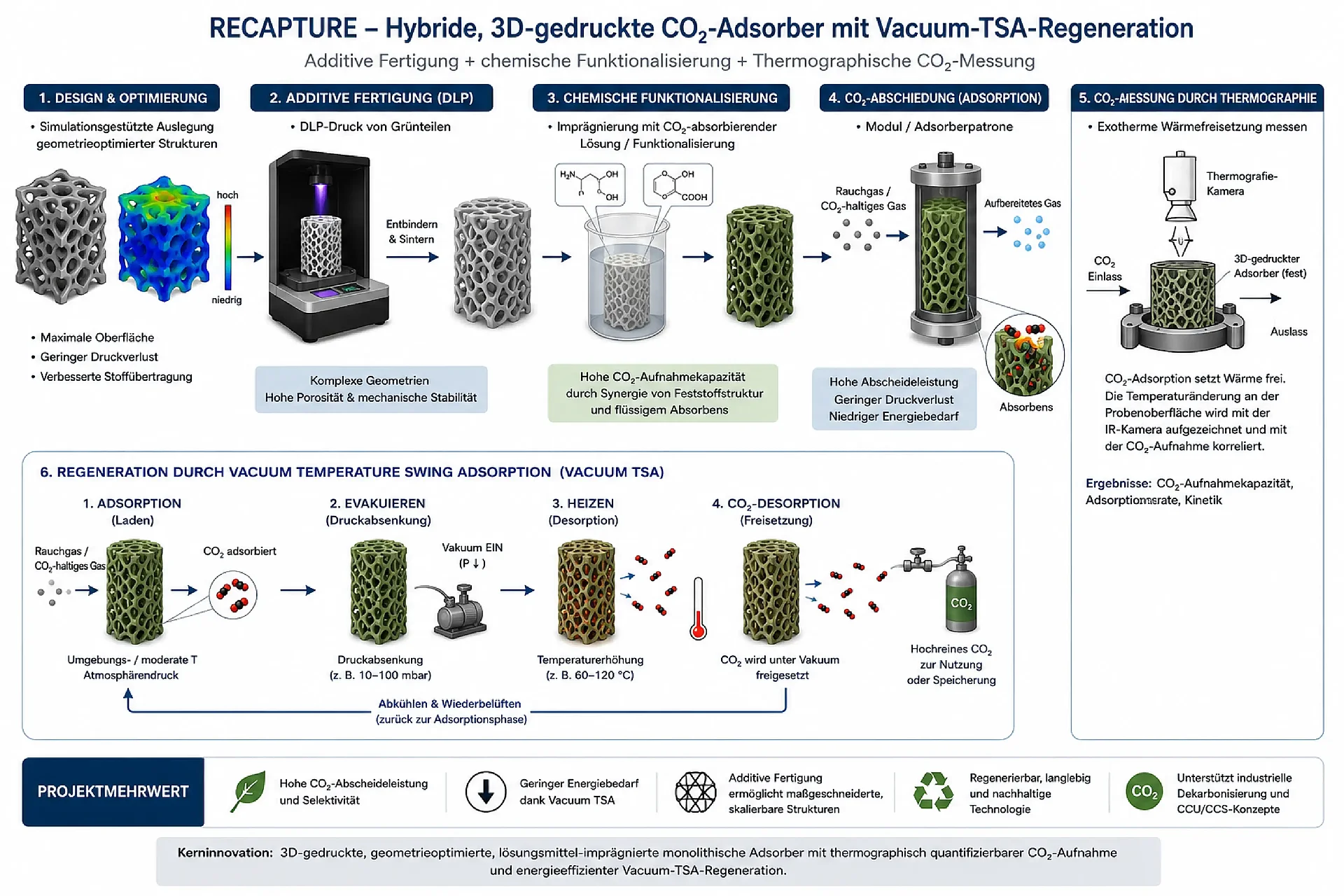
The KSF Institute at Furtwangen University has extensive experience in additive manufacturing, with a particular focus on Digital Light Processing (DLP) technology. Past work includes the development of novel material compositions for DLP printing, the optimization of printing parameters for high-precision manufacturing, and the investigation of post-processing methods—such as debinding and sintering—to improve mechanical and functional properties. Our research has helped advance the use of DLP in the fabrication of complex geometries and functional structures—particularly for applications that require high porosity and customized material properties.
The IPM Group at Furtwangen University has been active for several years in the fields of polymer chemistry, analytical chemistry, and surface technology. The group is increasingly focusing its research activities on the investigation of solid-phase chemical syntheses, such as solid-phase peptide synthesis. An extensive laboratory infrastructure is available – in particular for IR and UV/Vis spectroscopy, NMR spectroscopy, and chromatography-coupled MS methods (GC-MS, HPLC-MS) and UPLC.