
In brief
eCu-PARCA enables the electrochemical production of acetate from CO₂ as a platform molecule for a climate-neutral chemical industry. The process is based on an innovative electrochemical reactor with a particle electrode and a copper-based catalyst. A special membrane simplifies product separation. The project offers an efficient, scalable solution for utilising CO₂ in a green chemical plant.
What we’re working on
Motivation
The electrochemical conversion of CO₂ into higher-value products is a key building block for a decarbonised chemical value chain. Whilst many electrochemical CO₂ reduction approaches primarily target products such as CO or formate, the selective production of acetate remains challenging. Acetate is, however, an attractive target product, as it can be used as a platform chemical and a feedstock for biotechnological and chemical processes.
Innovation approach
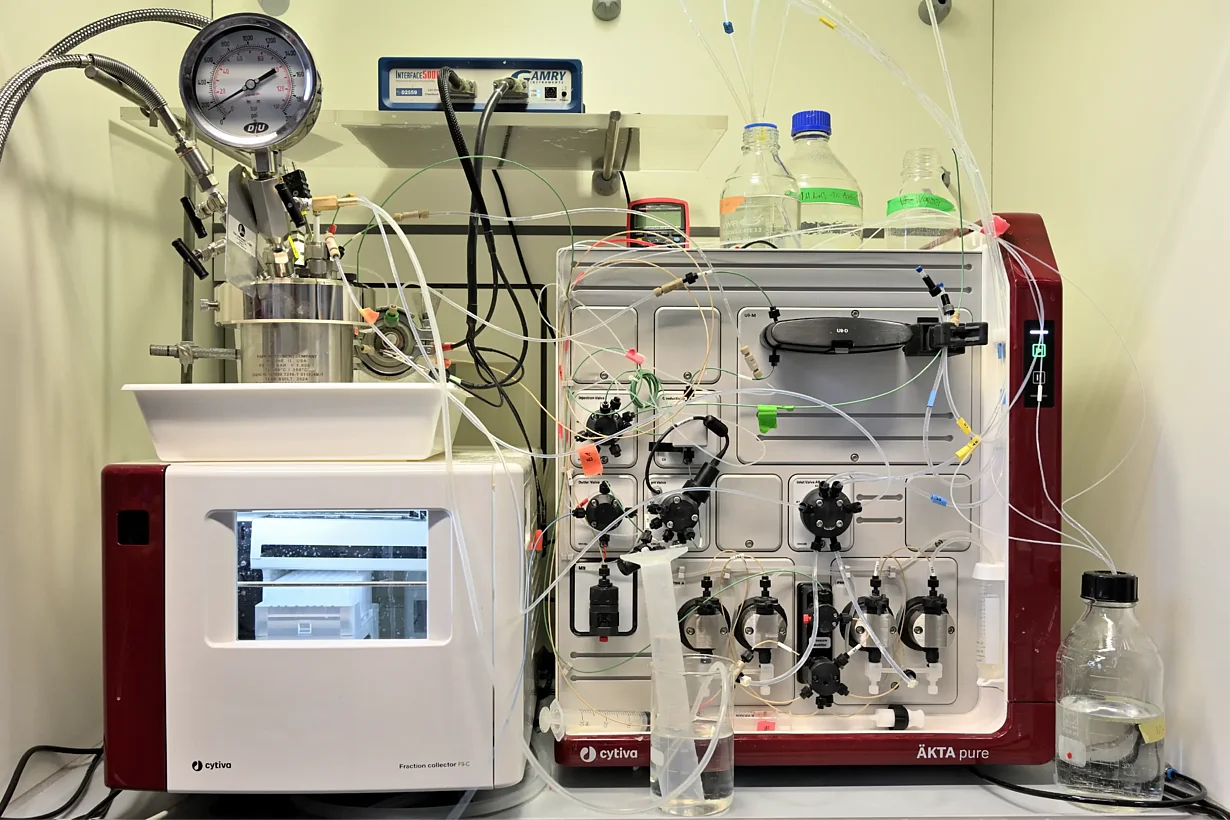
eCu-PARCA combines a high-pressure particle-bed reactor with copper-based catalysis. The focus is on the use of conductive particles as a three-dimensional electrode structure. This significantly increases the active surface compared with planar electrodes, whilst simultaneously improving mass transfer, heat dissipation and scalability. The combination with a homogeneous copper catalyst is intended to specifically shift the selectivity of CO₂ reduction towards acetate. The project thus combines molecular catalyst development, electrochemical reaction engineering and scalable reactor concepts.
Implementation and added value
The project aims to systematically optimise the reactor design, particle electrode, process pressure, electrolyte conditions and catalyst system in relation to one another. Key performance indicators include acetate selectivity, Faraday efficiency, current density, stability and transferability to larger reactor volumes. The added value lies in a modular and scalable platform concept that goes beyond conventional laboratory electrolysis cells.
The Karlsruhe Institute of Technology (KIT) combines cutting-edge research with application-oriented development in the natural and engineering sciences. The Institute for Functional Interfaces (IFG), where this project is being carried out, brings together expertise in materials development, bioengineering and fundamental chemical research. This interdisciplinary environment enables the development of functional materials and novel reactor designs that can be used to specifically address challenging catalytic reactions.